MIG Welding
(Metal Inert Gas)
City & Guilds Level 2 -Advance
Course
OverView
Course Overview
The Level 2 MIG Welding course will enable those who have already achieved a Level 1 qualification or are reasonably skilled welders to further develop their skills.
This course is appropriate for those looking to up skill and progress in the industry. This is an industry recognized qualification, which is sought by employers and will enable you to progress your career in welding, metalwork and fabrication. This is also a suitable course for companies wishing to support employees to up skill through continuous professional development.
Course Modules
This is a practical course through which you will develop welding skills typically found in industry, as well as relevant theoretical context, enabling learners to achieve welded joints in standard welding positions. This course will be delivered by one of expert industry experienced tutors, who will be able to guide and support you as you develop your welding skills.
You will learn the following:
Produce a butt weld in the flat position
Produce a butt weld in the vertical-up position
Produce a tee fillet weld in the vertical-up position
Produce a tube-to-plate tee fillet weld in the PB horizontal/vertical
position produce a lap fillet weld in the vertical-up position
Produce a tube-to-plate tee fillet weld in the PB horizontal/vertical position produce a lap fillet weld in the vertical-up position
Know the process and Health & Safety requirements for Metal
Inert Gas (MIG) welding
Know the process and Health & Safety requirements for Metal Inert Gas (MIG) welding
Assessment
You will be assessed through practical assignments and oral knowledge tests.
Course Syllabus
Course Duration: 6 to 8 weeks (3-4 sessions/week)
Prerequisites: Completion of Level -1 MIG Welding Course or equivalent experience
Certification: Advanced MIG Welding Certification
Module 1:
Advanced Welding Theory & Metallurgy
Theory (2 Sessions)
- Welding metallurgy: heat-affected zone (HAZ), grain structure, hardness
- Weld ability of different alloys (carbon steel, stainless steel, aluminum)
- Understanding weld distortion and stress relief techniques
Module 2:
Process Control and Advanced Parameters
Theory (1 session)
- Advanced arc types: Pulsed spray transfer, globular, axial spray
- Parameter tuning: voltage, amperage, inductance, and wire speed
- Selecting appropriate shielding gases
Practical (2 sessions)
- Setting up pulse MIG on advanced machines
- Evaluating arc quality and spatter control
- Experimenting with parameter changes and effects on welds
Module 3:
Out-of-Position Welding
Theory (1 session)
- Challenges and solutions in 3G (vertical) and 4G (overhead) welding
- Gravity effects, puddle control, and travel angles
Practical (3 sessions)
- Fillet and groove welds in vertical and overhead positions
- Multi-pass welding techniques
- Use of backing bars and support materials
Module 4:
Welding Specialty Metals
Theory (1 session)
- Aluminum and stainless steel MIG welding characteristics
- Thermal conductivity, expansion rates, and weld prep
- Filler material selection and storage
Practical (3 sessions)
- Welding aluminum using spool/push-pull guns
- Stainless steel welding using tri-mix or argon blends
- Surface preparation and post-weld finishing
Module 5:
Weld Defects and Testing
Theory (1 Session)
- Common weld defects: undercut, porosity, lack of fusion, cracks
- Non-destructive (visual, dye-penetrate) and destructive testing (bend, etch)
Practical (2 Sessions)
- Intentional defect creation and identification
- Performing guided bend tests and macro etching samples
Module 6:
Blueprint Reading & Weld Symbols
Theory (1 session)
- Welding blueprint basics and AWS weld symbols
- Welding Procedure Specifications (WPS) and Procedure Qualification Records (PQR)
Practical (1 session)
- Performing welds directly from a blueprint
- Reading and applying WPS instructions
Module 7:
Final Project & Certification
Practical (2 sessions)
- Fabrication of a complex multi-position weldment from blueprint
- Includes aluminum and stainless components
Assessment (1 session)
- Written test: metallurgy, defect recognition, process control
- Practical evaluation: based on WPS, blueprint accuracy, weld quality
MIG Welding Course · Enrolment
Choose Your Track
Three schedules built around real work and study commitments — same certified curriculum, different pace.
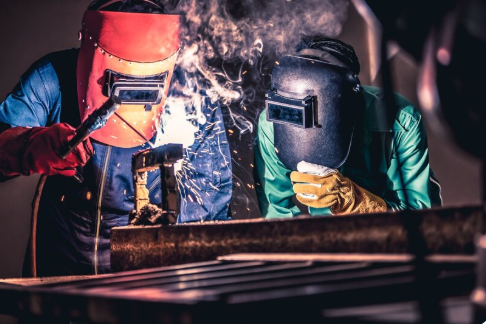
Materials & Tools
Required
- MIG welder (preferably with adjustable voltage & wire feed)
- Mild steel plates (2–6 mm)
- Welding wire (ER70S-6 for steel)
- Shielding gas: Argon/CO₂ mix
- PPE (helmet, gloves, jacket, etc.)
- Grinder, wire brush, chipping hammer, clamps
Ready To Build Your Future?
Enrol today and take the first step towards a rewarding career in welding and fabrication.